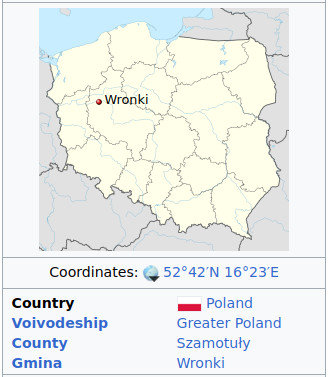
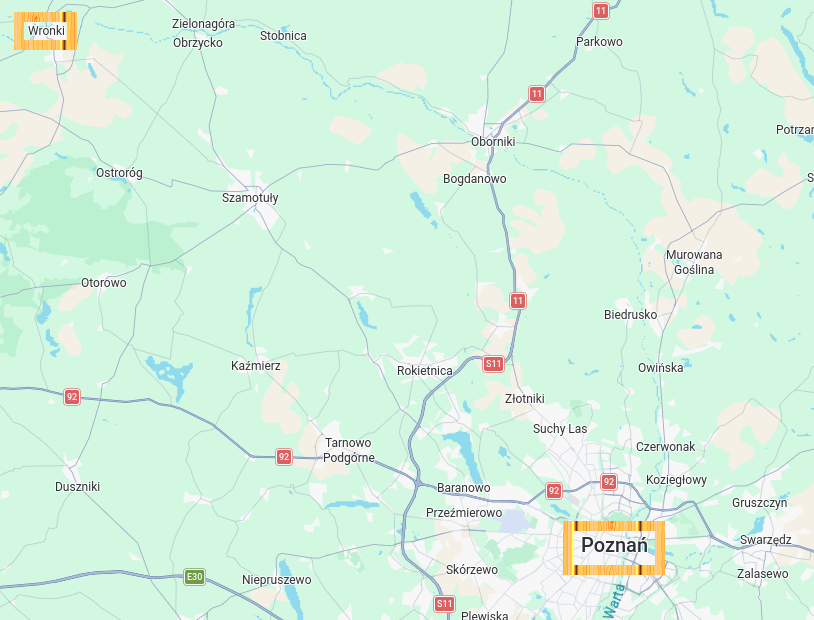
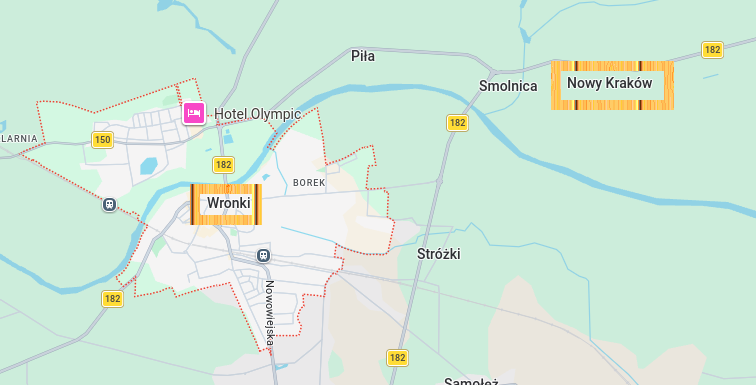
In 2026 I engaged a Polish researcher to find Rudolph's birth record. Instead of locating it in East Prussia, he found the following in Wronke, Poznan:

Because this record varies from the expected in two key places - date and name - it took me a while to accept this document.
There is no iron-clad evidence in US records that identifies his place of birth. Most genealogies reference the immigration record. That record also states his occupation as "shoemaker". I found a matching emigration record from Hamburg that also gives his occupation as "schuster" (cobler/shoemaker), but that record shows his home as Wronke, Posnan! I think that the german-made entry should be expected to be more precise than the American-made entry. Given that Rudolph is listed - in his Obituary, the 1920 Census, and his first marriage - as a "tannner" I am comfortable that this association with leather working supports the linkage of our Steinbach to the one in the immigration/emigration documents.
The names of his parents are documented in marriage records. In his Pennsylvania marriage to Anna Wagner his parents are Fredrick and Louise Steinbach. I recently succeeded in linking him to a second (brief) marriage in Wisconsin to Albertina Heckey and in that document (as transcribed by me in person) his father is (again) Fred and his mother is LORNA KANT! (I could easily have mis-read "Louisa" as "Lorna" if written in script, especially given that at the time I did not think this was my Steinbach.) This matches well with the birth record found in Posnan.
His name on the birth record is "Rudolph William", and "William" shows up in none of the documents I have found in the US. However, my Polish researcher observed that many German's living in Posnan seem to include William as a middle name at birth and then never use it again. I surmise this may be in honor of the Kaiser.
The birthday remains the greatest concern for me.
The 1900 census claims "June". My transcription of his death is "Jun 06". His obituary says "Jan 06".
Yet his birth record says Jan 07!
I notice that the page seems to be sorted in birth order, and not in baptismal order, although this
is a baptismal record. I would expect the baptismal date to be a recorded date and the birth date to be a
reported date, so I suspect that the individual records were logged elsewhere and then entered at a later
date in birth order. I also notice that Rudolph's is the only baptism to occur only one day after birth.
This is not unusual in Catholic families, but is less usual in Protestant.
My researcher has found an earlier son of this couple that lived only 4 days in 1859.
I wonder if the parents rushed the baptism in fear of another infant death?
In any event, even for a people that cared enough about birth dates to invent the birthday party, I can
imagine that an error of one day in memory or recording is understandable.
When Rudolph was born, in 1864, Prussia was the leading member of the North German Confederation. It had successfully driven Austria and its southern German allies out of the German Confederation and the Hohenzollern family provided its leadership. Prussia had held its eastern provinces out of the Confederation and their resources gave the family leverage in Confederation politics. (Austria had done the same with its Hungarian holdings.)
In 1871, when the Prussian war machine destroyed the French in the Franco-Prussian War, the southern German princes (excluding Austria) joined the Northern Confederation and created the Empire of Germany under Hohenzollern leadership. All the former Prussian provinces were included in the new Germany. Soon thereafter Germany became the world's second largest economy - trailing only the United States. Despite a long German tradition of "states rights", the Hohenzollern leadership preferred organizational efficiency to personal freedom.
In 1888 Rudolph emmigrated to the United States.